
I’m not being that productive nowadays, partly because I’m only watching a drama right now and my internet connection is still merciless to give me opportunity to watch even that single drama. With that reason, I am currently watching the dramas that I’ve watched before (only bits, I skipped some parts that annoyed me). I came across some periodic or historical Kdramas, which is also known as sageuk, and I’m thinking, “How about searching for some info about the clothing?” The colorful hanboks always make the actors and actresses look better, so why not gain some knowledge about them, even only by knowing their names? It doesn’t hurt anybody, I think. And another reason : because I miss the actors and actresses in hanboks.
Before that, still recognize them?

The gisaeng-turned-fighter, and
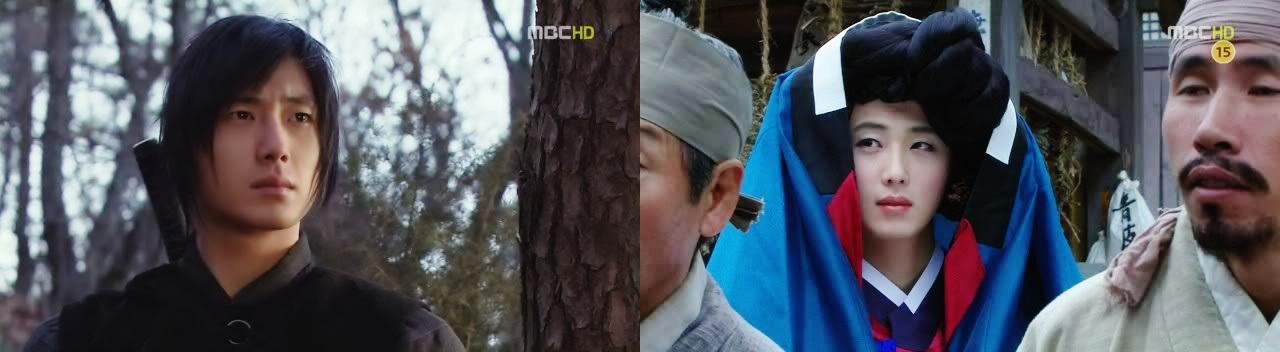
the fighter-turned-gisaeng?
Let’s start our lesson!^^
Basically, traditional Korean clothing is known as hanbok. The term is used generally to describe the outfit for both men and women, so don’t get confused! What makes the difference between them is the parts of the hanbok.
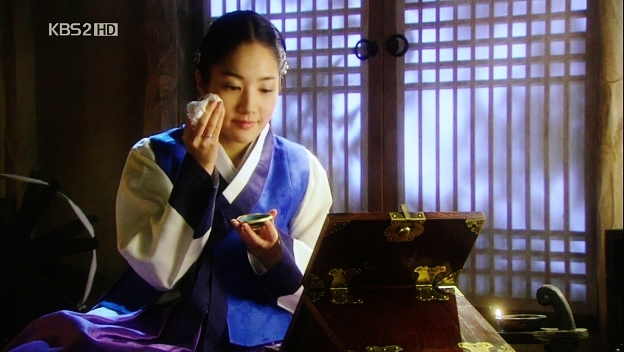
For women, hanbok consists of two main parts: jeogori (저고리):the blouse-like top part, and chima (치마): the skirt-like bottom part. The fabric and colors used to make jeogori and chima depend on the status of the person wearing it. The royalties, court figures, and upper class people (yangban) use expensive materials such as silk and satin with bright colors like blue, red, green, and yellow. The middle-class and lower-class people always use cheap and durable fabric that can be worn for a long time like ramie, hemp, and cotton with light earth colors, for instance, brown, light blue, and green.
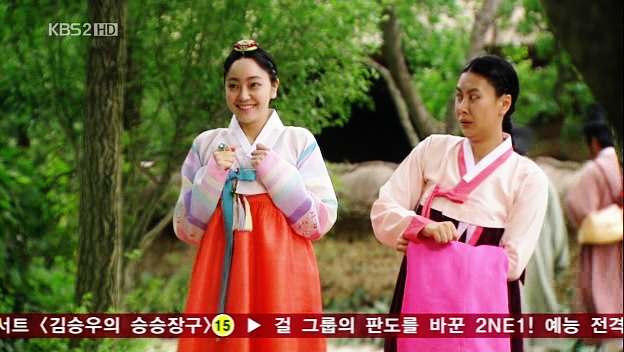
Hyo-Eun dons a bright-colored hanbok, befitting her status as Minister of War’s daughter
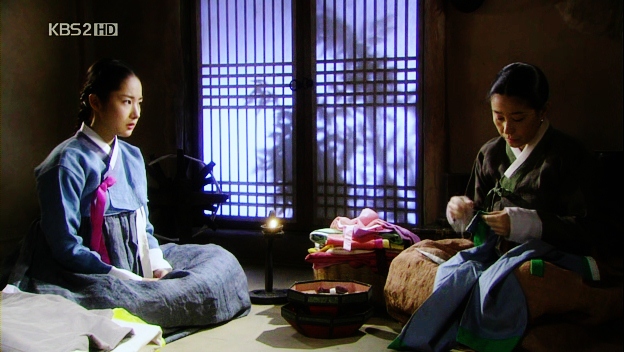
Yoon-Hee wears a light blue jeogori and blue chima
As for the entertainers like gisaengs and dancers, they don bright-colored hanbok too, fitting their roles in society as people who attract others’ attentions. Gisaengs, for instance, wear hanbok made of silk and satin that enhance their beauty with the usage of pretty and high quality fabrics. The fabric used for a gisaeng’s jeogori is usually of translucent type such as gossamer silk, which gives off a sexier vibe, fitting a gisaeng’s identity. For the chima, one of a gisaeng’s usually made from silk material.

Jeon-Hyang donning a translucent crimson jeogori
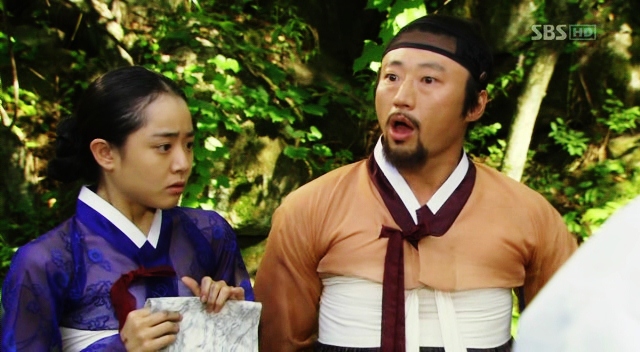
Yoon-Bok with a translucent blue jeogori on while Hong-Do wears an ordinary brown (woman’s) jeogori
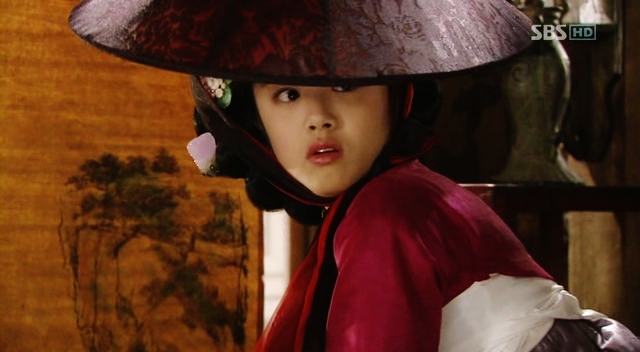
Yoon-Bok wearing a crimson jeogori during her disguise as a gisaeng (again)
A norigae (노리개), a common, pendant-like ornament is tied to the jeogori’s string or waist of the chima to give a luxurious look to the whole outfit.
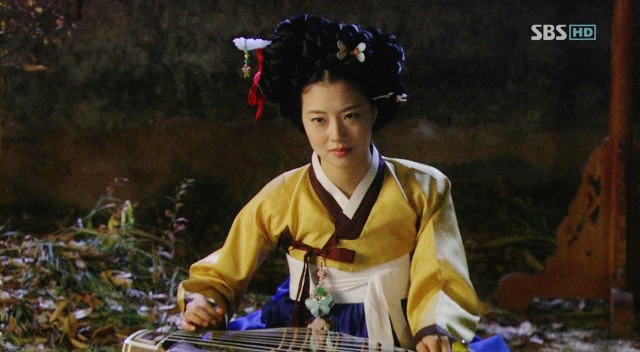
Jeon-Hyang having a butterfly-shaped norigae tied to her jeogori
Jangot (장옷) is a clothing used by women as veil to cover their faces. It is almost the same as jeogori and durumagi, but it is longer and it has collar. It is worn over the head, covering the head, body, and face.
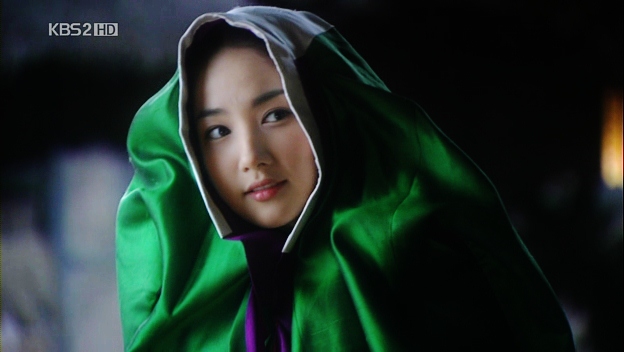
Yoon-Hee with a green jangot around her body and head
Another type of veil, known as sseugae chima, is made like a chima, but it is used as a veil to cover women’s face.
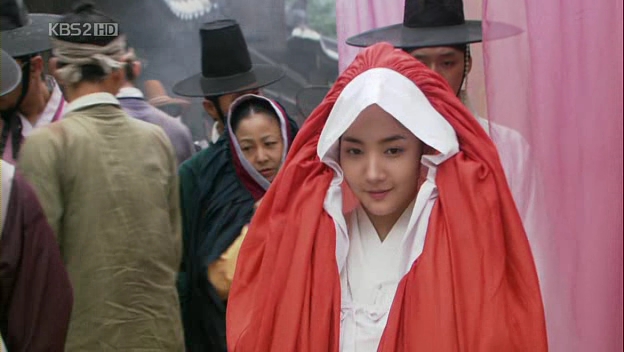
Yoon-Hee wearing a sseugae chima to hide from Seon-Joon
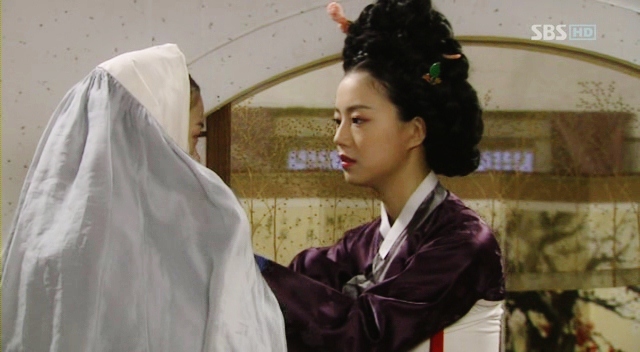
Jeon-Hyang is helping her maid wearing sseugae chima
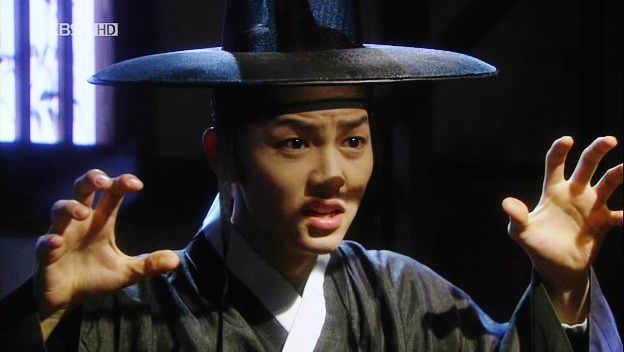
As for men, they also have jeogori as a part of their hanbok. However, the jeogori for men are usually longer than women’s jeogori. They wear it with baji (바지), a type of traditional Korean pants. Sometimes, baji is also used as undergarment clothing for women. Both jeogori and baji are usually of made of same fabric of light colors, such as light blue or white.
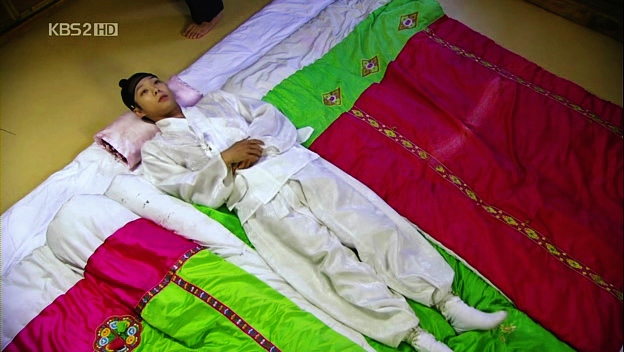
Lee Sun-Joon wears white jeogori and baji
Most of the time, men wear another layer of clothing on top of them, which is generally known as durumagi (두루마기), or an overcoat. It was commonly used by upper class men for housecoat but only used by commoners as an outdoor cloth. Women also wear durumagi for special occasions.

Yoon-Hee and Sun-Joon wearing durumagi inside the house while Sun-Joon is looking quite scary here^^;
There’s another type of overcoat in hanbok, known as po (포). It is worn by scholars as their daily garment and government officers when they’re out for private business.
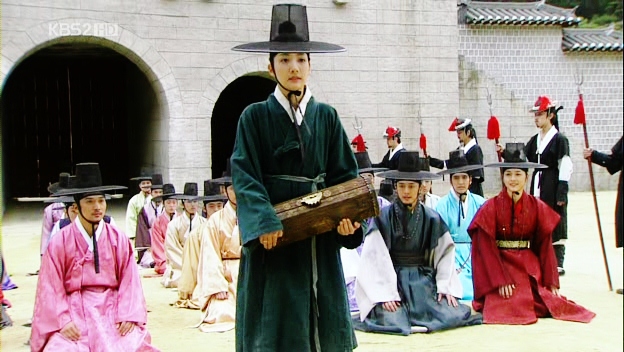
Yoon-Hee and a bunch of other scholars behind her are wearing po
Some men also wear baeja (배자) or magoja (마고자) on top of their jeogori. Baeja is a sleeveless outer jacket or vest worn on their own while magoja is an outer jacket with long sleeves worn with a thin vest inside called jokki (조끼).
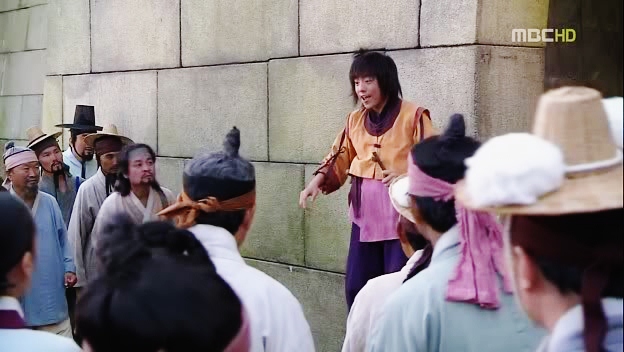
Dol-Yi with an orange baeja on
For children, they have special hanbok for them. For boys, a type of po called sagyusam (사규삼) is worn on top of jeogori. It is usually paired with hogeon (호건), a headdress made of black fabric with golden embroidery on it while for girls, saekdongot (색동옷), a type of overcoat with patches of multi-colored fabric sewn together, is worn along with batssi daenggi on the hair.
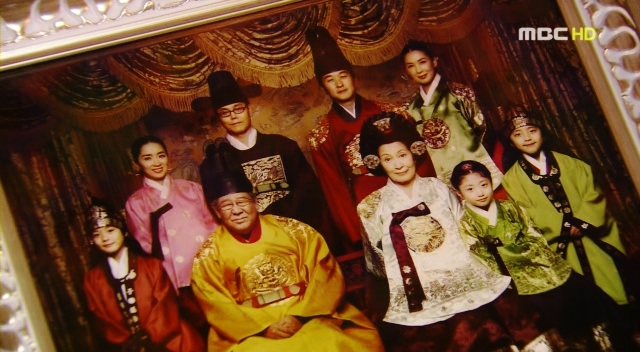
The young princes are wearing sagyusam and hogeon; Shin in red and Yul in green
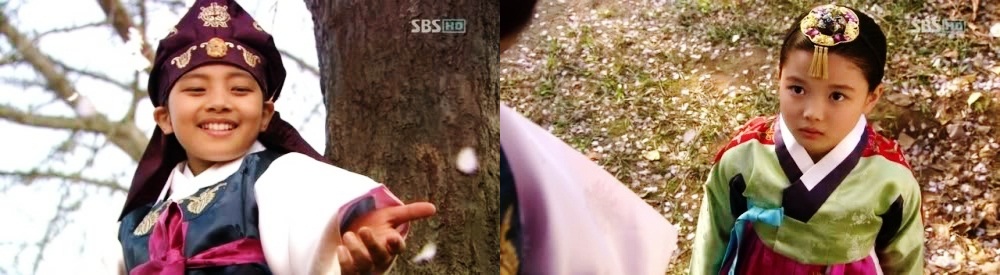
Little Geom is wearing maroon hogeon while little Eun-Chae is wearing saekdongot and baetssi daenggi
Now, moving on to the endless type of hats, headgears, and accessories.
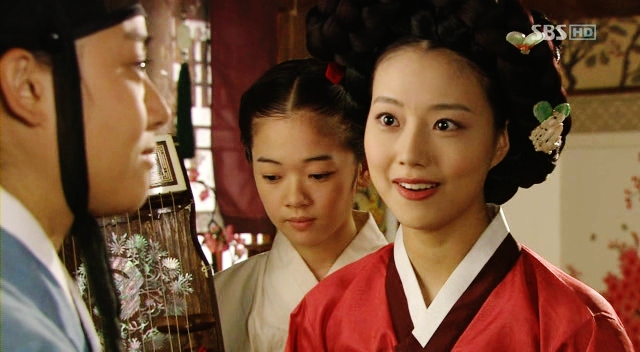
Most of the sageuks that I’ve watched before this must have featured at least one of the women wearing heaps of her hair on her head. I remembered those silly old days of mine where I tried to imitate that hair and hanbok using towel and blanket. Hum. As for women, the accessories worn by them depends on their hairstyles.
The most common hairstyle in Kdramas, known as ‘Daenggi Meori’ (댕기 머리), is a style where the hair is made into single braid and a large ribbon, known as daenggi (댕기), is attached to the end of the braid, thus earning the style its name. Only unmarried women wear this kind of hairstyle. Besides daenggi, another additional accessory, known as baetssi daenggi (배씨 댕기), is also worn on top of the head. Baetssi daenggi can be made of thin, cloth-like material or soft material like cotton stuffed into colored cloth.
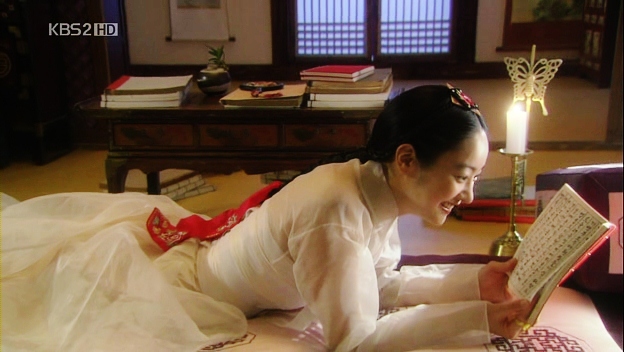
Hyo-Eun wears red daenggi and baetssi daenggi
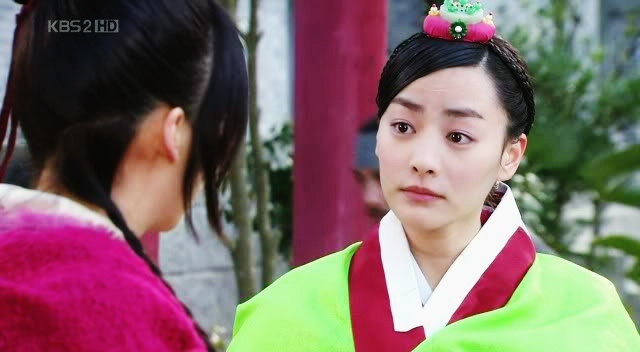
Eun-Hye with another type of baetssi daenggi on
For married women, they have another hairstyle, known as ‘Jjeokjin Meori’ (쪽진 머리), where the hair is brought to the back and tied into a bun behind the neck. A pin, known as binyeo (비녀), is used to hold and fasten the bun in its position. The design of binyeo reflects the social status of the person wearing it. The length also varies, depending on its function: whether for a pin or for decoration purpose. Some smaller pins called dwikkoji (뒤꽂이) are sometimes pinned on the bun. Both binyeo and dwikkoji also have another function: serving as an an earpick (..oh). Also, people of the palace, such as royalties and court ladies wear another accessory, known as cheopji (첩지), on their head. Cheopji, unlike baetssi daenggi, is made of metals in the shape of dragon, peacock, phoenix, duck, bird, frog, or flowers. Some shapes of cheopji are restricted according to the rank, for instance, dragon for the queens and phoenix for the princesses.
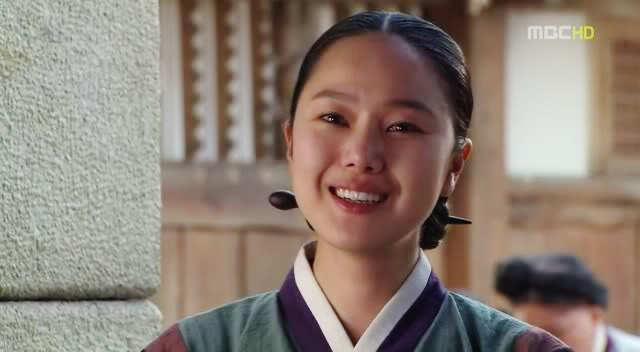
Wol-Hee wearing a binyeo made of wood
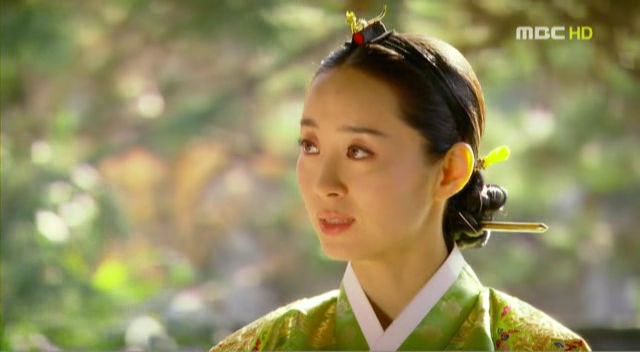
Queen Min wearing a gold binyeo, a yellow dwikkoji, and dragon-shaped cheopji
Sometimes, the married women also tie their hair into a bun and bring it to the top of their head. This style, ‘Eonjun Meori’ (얹은 머리), is quite popular too. Just like what in sageuks, wigs, known as gache (가체), is used to make the bun fuller and more impressive. At first, real hair was used, but there was death recorded due to too much weight of the wigs, so it was switched to false hair. Binyeo, combs, and pins are used to decorate the gache. Because gache was so expensive, not many women could afford it, and this style were more popular among gisaeng. When they went out, they donned jeonmo (전모), a hat made of bamboo and paper, or cloth.
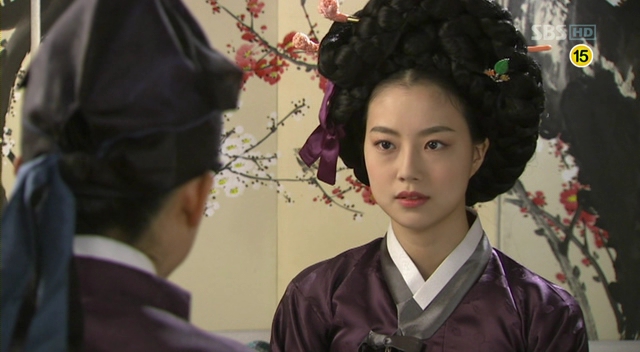
Jeon-Hyang wears gache decorated with hair pins and ribbon
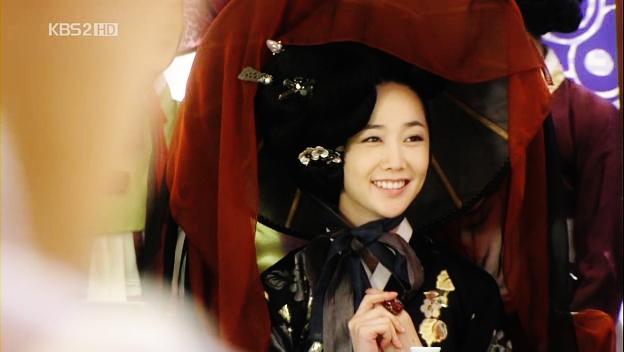
Cho-Sun with her gache and her pretty jeonmo
For queens, king’s wives, and queen mothers, they use ‘Eoyeo Meori’ (어여머리) hairstyle, also known as royal hairstyle. Consisting of false hair, it is made into a thick braid and secured on top of the head, with the original hair showing in front of the false one. The braid is decorated with ribbon and a pair of tteoljam (떨잠), round-shaped ornaments with fluttering metals. The ornaments depict the person’s rank and position.In special ocassions, high-ranking court ladies also wear this hairstyle.
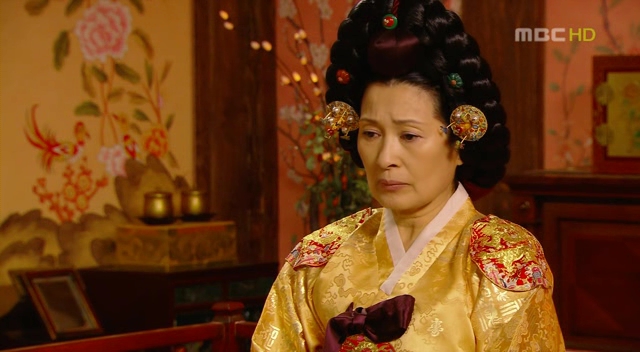
Queen Mother with the braid and tteoljam
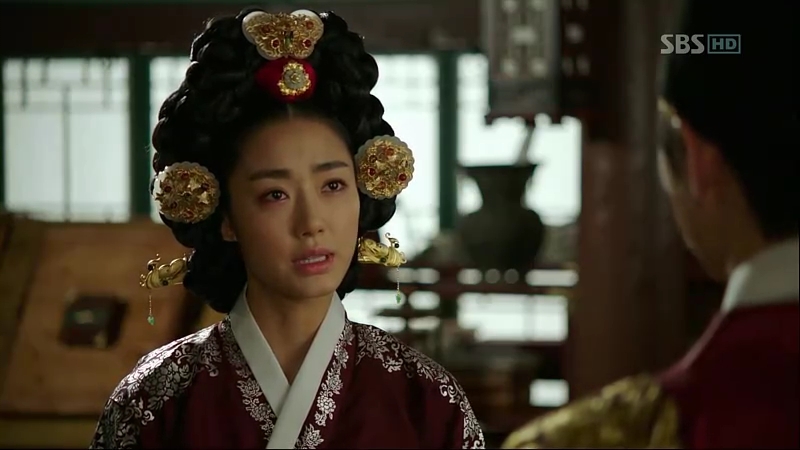
Queen Soheon with the eoyeo meori style, together with tteoljam and binyeo
Finally, ‘Keun Meori’ (큰머리) : a hairstyle that can only be seen worn by people of the palace. It is the same as Eoyeo Meori, but it has an additional part called tteoguji (떠구지) that is added for emphasis. Originally, it is also made of human hair, but because of its weight (again), it is replaced with wood, carved and painted black to match the hair.
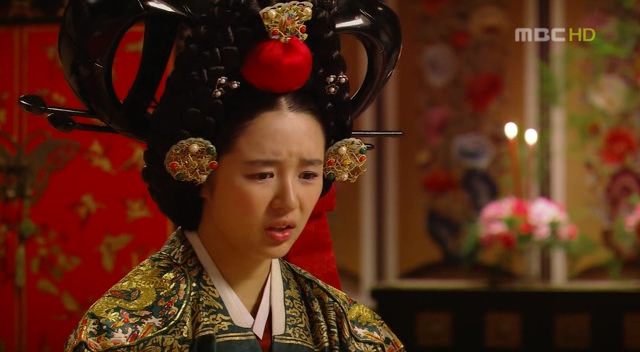
Chae-Kyung wearing the braid, tteoljam, and tteolguji for her first night ritual
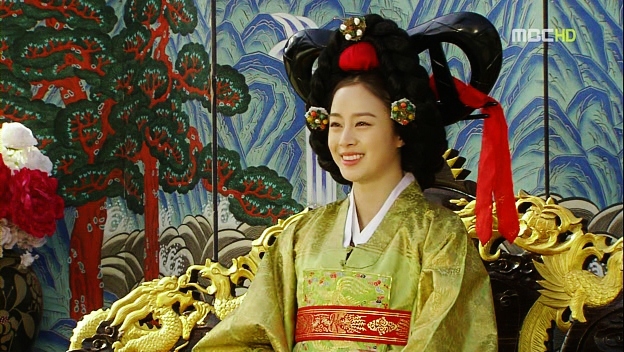
Lee Seol acting as a princess, dressed completely with braid, tteoljam, and tteolguji
When winter comes, women usually wear a variety of caps to keep their head warm. There are a variety of such caps, such as pungcha, ayam (아얌), jobawi (조바위), and nambawi (남바위). They differ in length and size. Some are lined with fur and decorated with ornaments and gemstones such as jade and amber.
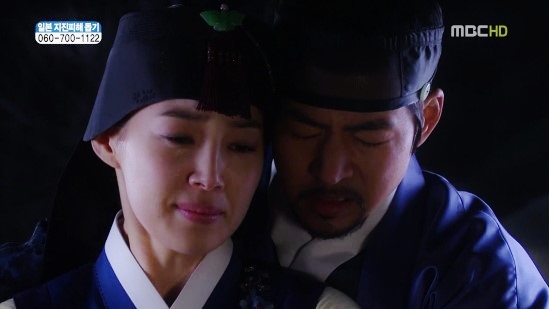 Dong-Nyeo wearing nambawi without fur lining
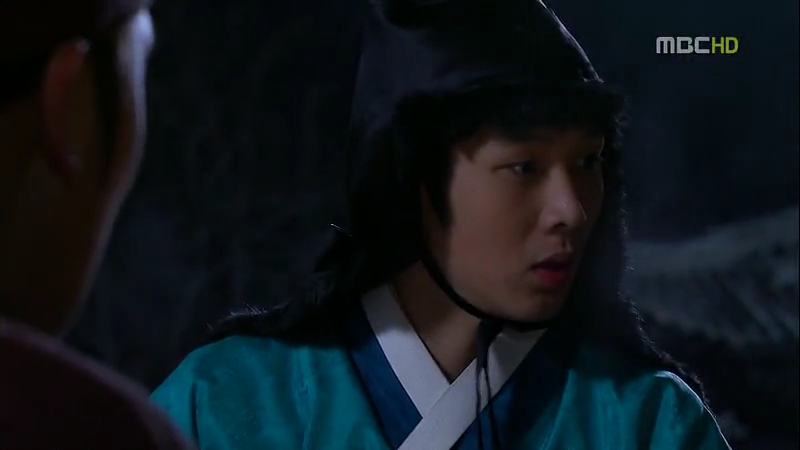 Gwi-Dong with another version of nambawi, lined with fur but without any gems
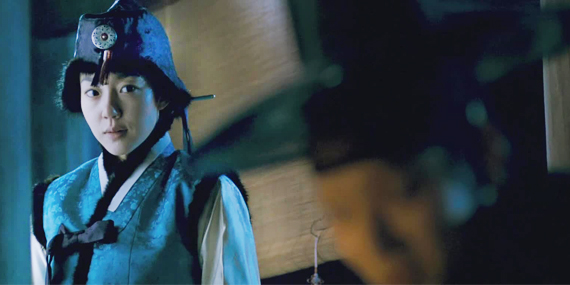 In-Kyung the widow is wearing a jobawi
 Geum-Ok wearing pungcha, covering the ears and neck.
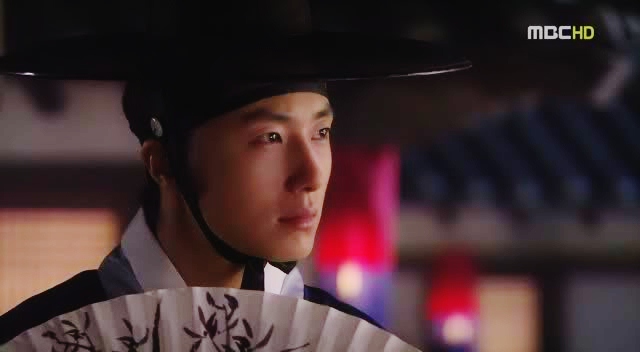
As for men, they only have two hairstyles : whether to bring the hair to the top and tie it into a knot known as sangtu (상투), or let it loose down, like what the two Iljimaes and Moon Jae-Shin do. But men have many hats to be worn with their simple hairstyle.
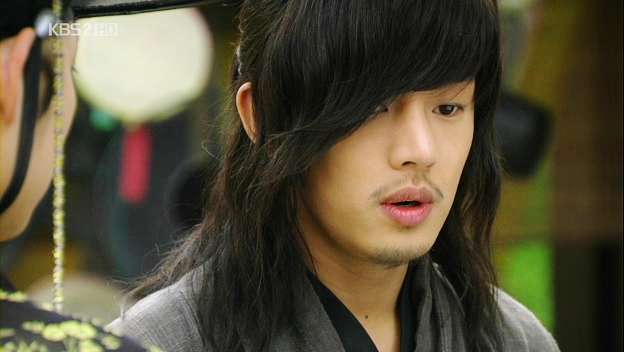
Rugged hairstyle of Moon Jae-Shin
Gat (갓) is the generic term for the hat worn by the noblemen. The most common hat worn by men is made of horse hair and transparent black in color. Not only it protects the sangtu, it also represents the rank of the person wearing it. The black hat is known as heukrip (흑립) and worn by upper class men. For commoners, a hat made of bamboo, known as paeraengi (패랭이) is widely used.
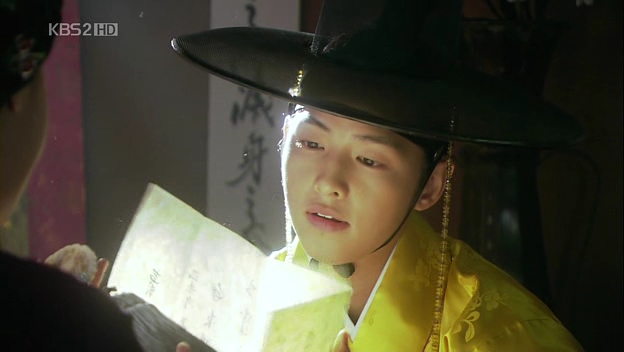
Yong-Ha with a transparent black gat

Sun-Joon shooting an annoying glance at his gat
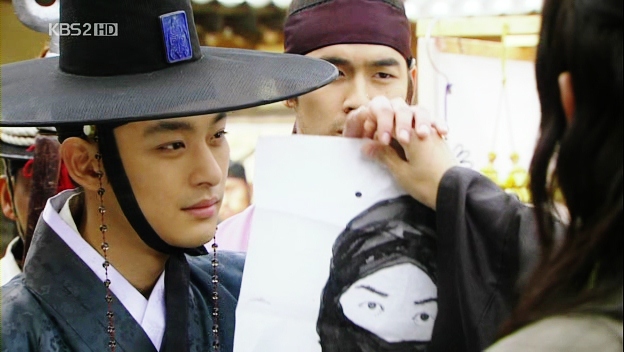
In-Soo wearing a heukrip
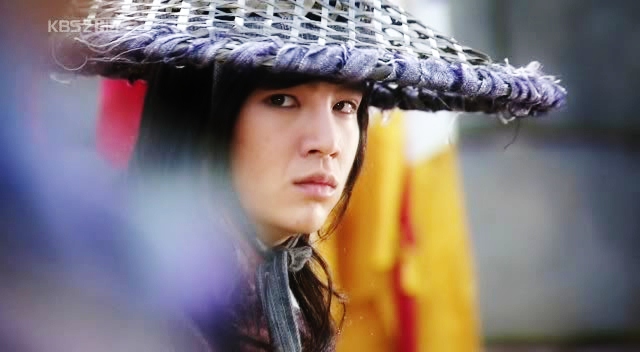
Chang-Hwi wearing a paerangi
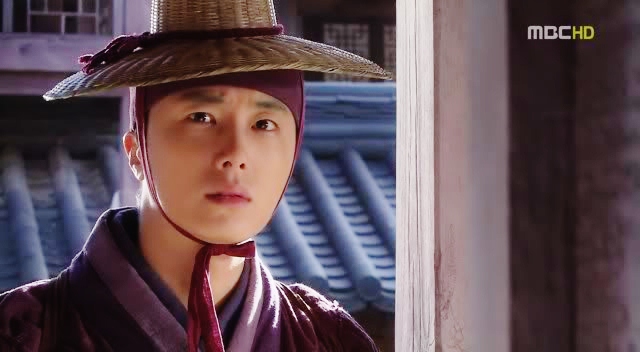
Iljimae wearing a smaller size paerangi
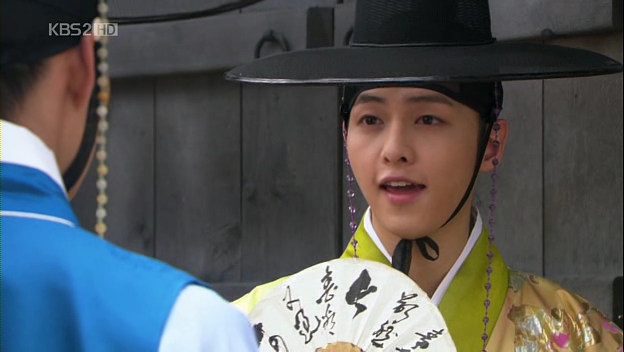
Remember those long, colourful string of beads hanging from Yong-Ha and other noblemen’s gat? It is known as gatkkeun (갓끈) or hat strings and not everyone has the chance to wear it. It is only restricted to the noblemen and the men of lower class can only wear the gat.
Sometimes, men wear tanggeon (탕건), a type of hat under the gat. It can also be used indoor.
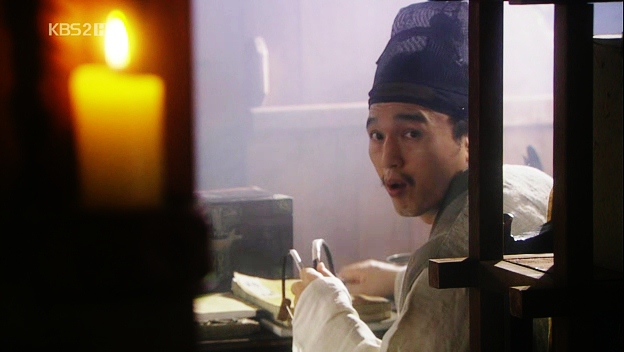
The bookstore owner with his tanggeon on his head
Underneath the gat and/or tanggeon,, the sangtu is held together using a pin called donggot, and to keep the hair from falling, a headband, manggeon (망건), is worn on the forehead.
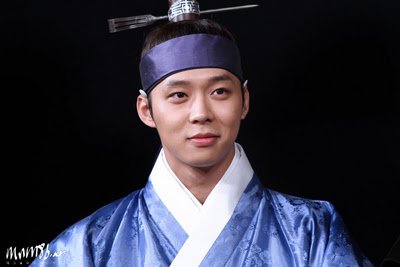
Sun-Joon a.k.a Yoochun with sangtu and donggot
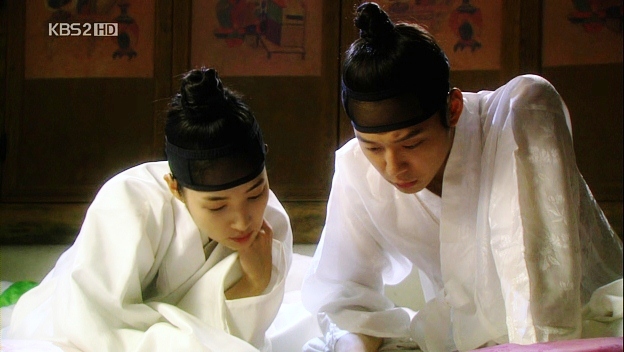
Yoon-Hee and Sun-Joon wearing manggeon on their foreheads
Thanks to Karen, I found out another thing. There are a pair of small buttons attached to the manggeon. Depending on the shape, the name varies. Gwanja (관자) have the shape of rings while pyungjam have the shape of half-moon. Both of them have similar purpose: they function as decorative ornaments as well as denoting the rank of the wearer.
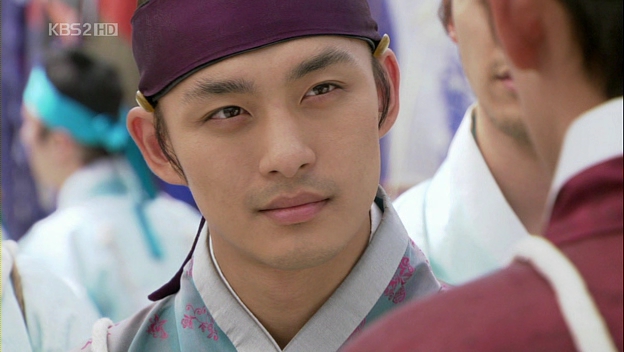
In-Soo wearing gwanja
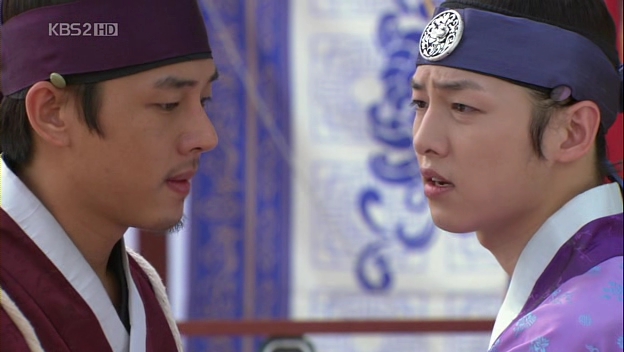
Yong-Ha and Moon Jae-Shin with gwanja, with Yong-Ha having them matching with his hanbok colour for fashion
Another common type of hat, satgat (삿갓), is a conical-shaped hat made of straw, is commonly used by farmers or monks, and mostly used as an undercover hat in sageuk. There’s another variation of satgat, called banggat (방갓).
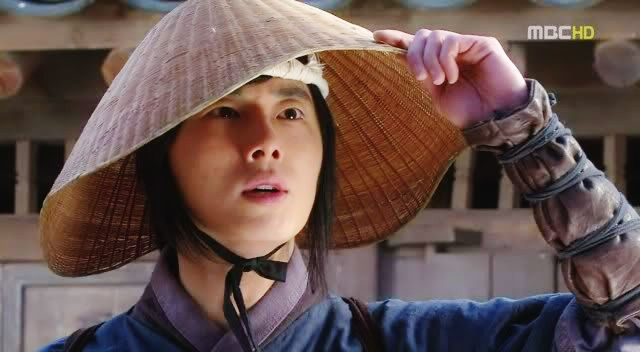
Iljimae with a banggat
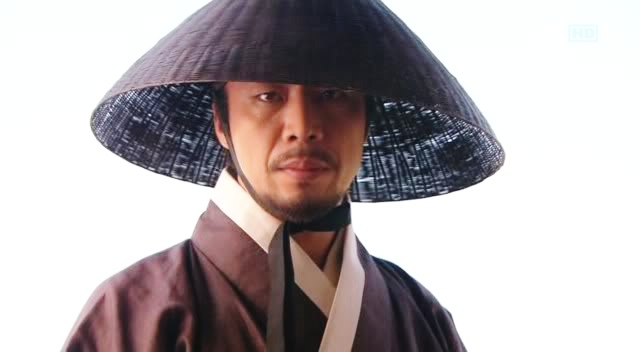
Kong-He, also wearing a satgat
For military personnel, they wear a special hat called beonggeoji (벙거지). Also known as jeonrip, it is styled according to the wearer’s rank.
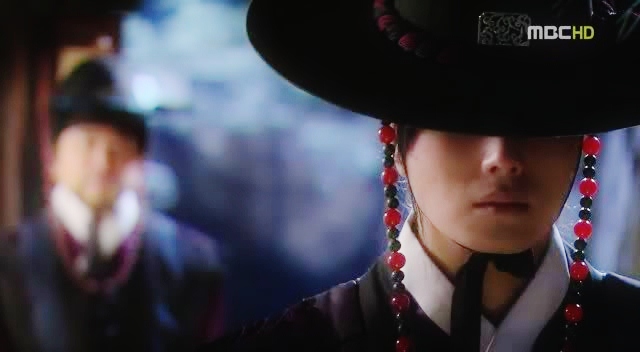
Iljimae wearing a jeonrip during his escape
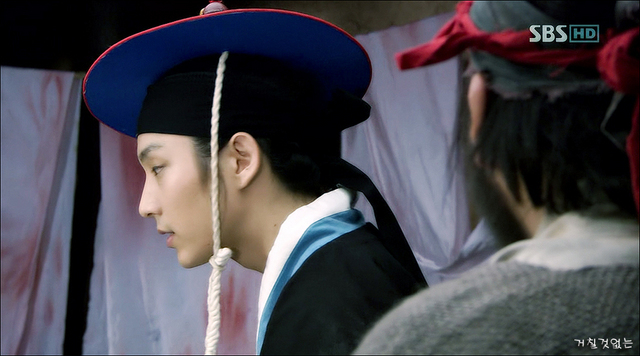
Another version of Iljimae is wearing beonggeoji during one of his disguise
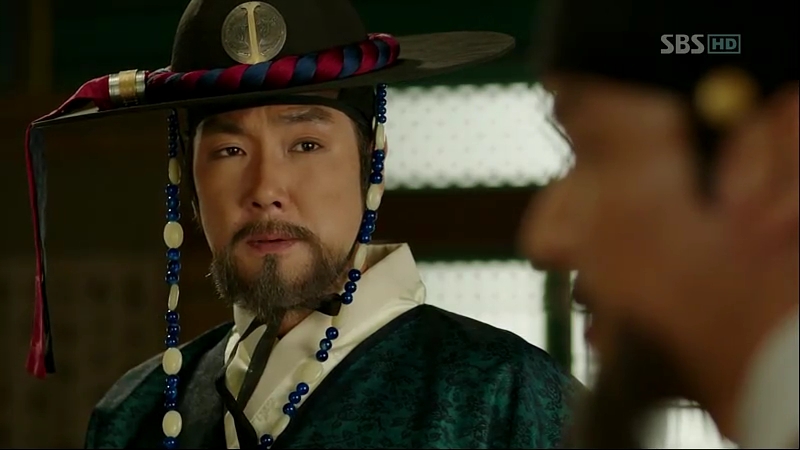 Moo Hyul with a jeonrip decorated with beads, fitting his rank as Royal Chief Commander
For Confucian scholars, they wear bokgeon (복건), a headdress made of black fabric. It later evolves and is used as a headdress for boys.
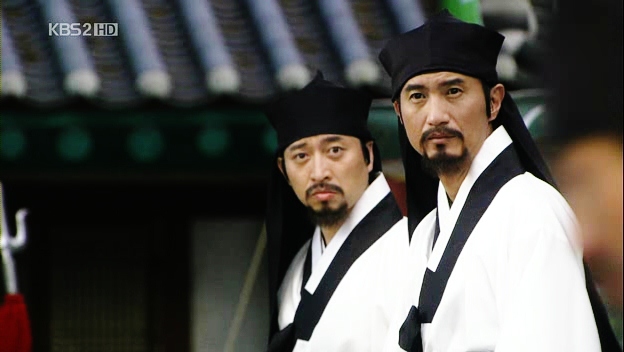
Prof Jung and Prof Yoo both wear bokgeon
For noblemen, they often choose to wear jeongjagwan, another type of headdress. It is usually worn indoor and consists of several layers, whether double or triple and has pointed ends. It is also made from horsehair.
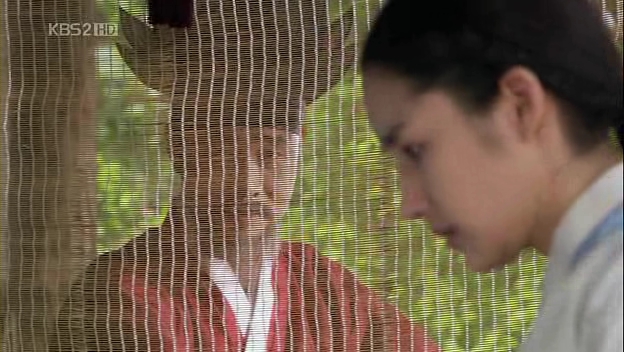
Minister of War is wearing jeongjagwan behind the veil
Finally, the clothes for special ceremony and/or restricted to people of the palace.
Hwarot (활옷) is reserved for princesses for ritual attire. It is also used by noble families as a topcoat for the bride during wedding ceremonies. It is worn along with hwagwan (화관), a traditional Korean coronet and ap daenggi, a type of daenggi which is worn in pairs and hanging from a long yongjam, a long hairpin which has a dragon head patterin on one of its end. Ap daenggi is hung in the front, while another type of daenggi called doturak daenggi, a wider silk with golden patterns, is hung from the coronet at the back. Daedae, a red colored sash made of silk with golden patterns is worn around the waist like a belt and tied at the back of the hwarot.

A hwarot hung inside Princess Kyung Hye’s quarters alongside some dangui and wonsam

Mi-ho looking over at a bride wearing a hwarot, hwagwan, and ap daenggi
 Eon-Nyeon in a hwarot, with a jokduri and a pair of ap daenggi hanging from a yongjam
Wonsam (원삼) is another type of topcoat worn by royalties, high-ranking court ladies, and noble women during ceremonies. The colors and decorations of the wonsam determine the rank of the person wearing it. For commoners, wonsam is another choice for wedding topcoat as hwarot can be too expensive for some household. Jokduri (족두리), another type of coronet but less elaborate in terms of decorations compared to hwagwan, is usually donned with wonsam.

Chae-Kyung with a light green wonsam decorated with gold prints, daedae, and a jokduri
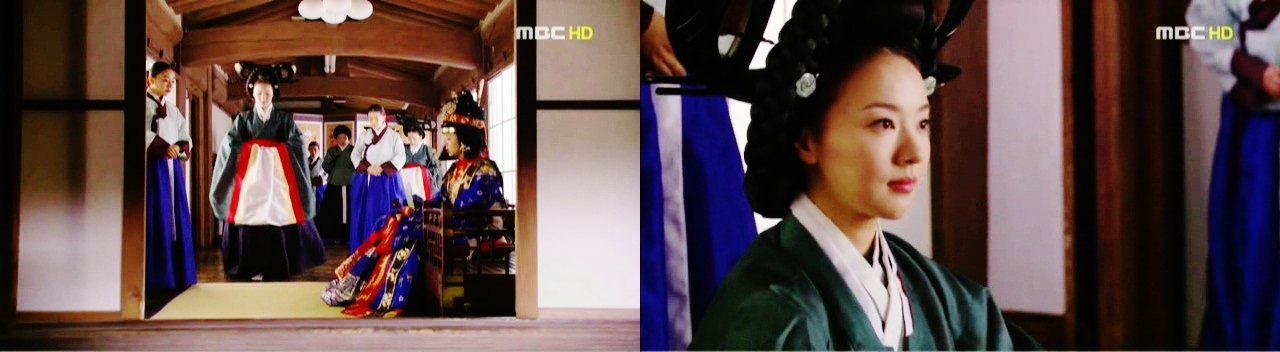
Court Lady Choi with a dark green wonsam
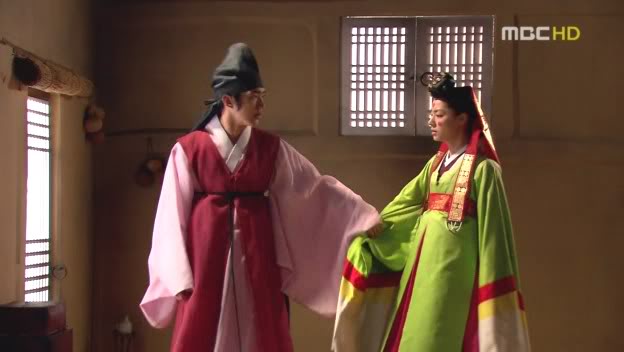
Hyang-Dan wearing a wonsam with less decoration and jokduri. The daedae and doturak daenggi at the back are quite visible here
Dangui (당의) is a type of upper garment, usually worn on top of jeogori. It is worn by queens, queen mothers, princesses, and court ladies. The difference between dangui of royalties and of court ladies is the golden pattern on it, called geumbak (금박), that can only be worn by royalties. Geumbak is also put on chima that is going to be worn with the dangui.
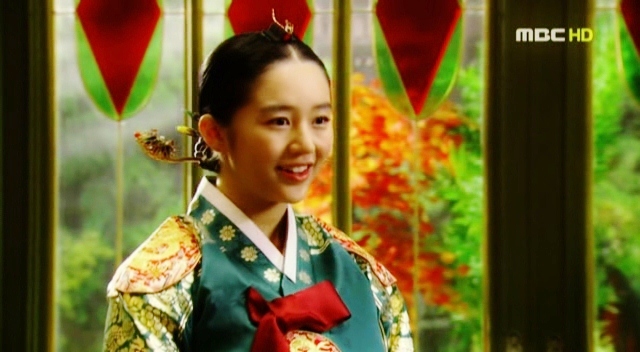
Chae-Kyung wearing a dark green dangui, with binyeo, dwikkoji, and cheopji
For government officers, their daily clothes when they are out doing their official tasks is generally called gwanbok. It differs according to various ranks and positions of the wearer. There is also another type of clothing, known as cheollik, worn by kings and officers. Both gwanbok and cheollik is worn with samo (사모), a type of Korean hat and gakdae (각대), a type of Korean belt. Gwanbok is also worn by commoners during their wedding ceremony.
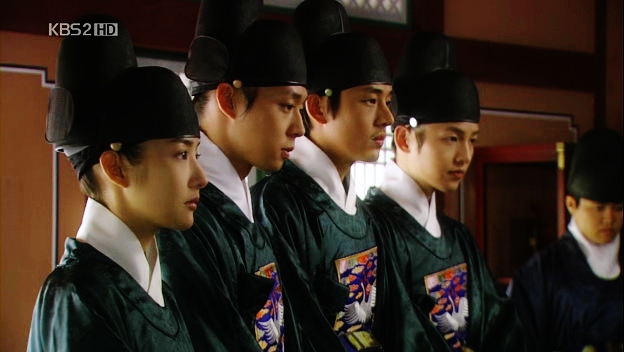
Jalgeum Quartet in dark green gwanbok and samo
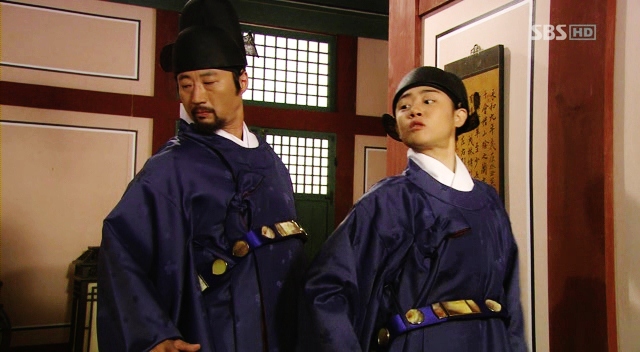
Hong-Do and Yoon-Bok showing off their blue gwanbok and gakdae
Special for kings, their daily garment is called hongryongpo, decorated with patterns of dragon in gold. It is worn along with ikseongwan, a type of headgear and gakdae.
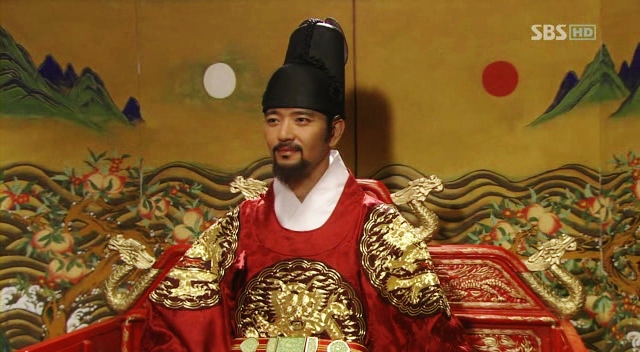
The most handsome version of King Jeongjo in a red hongryongpo with ikseongwan and gakdae
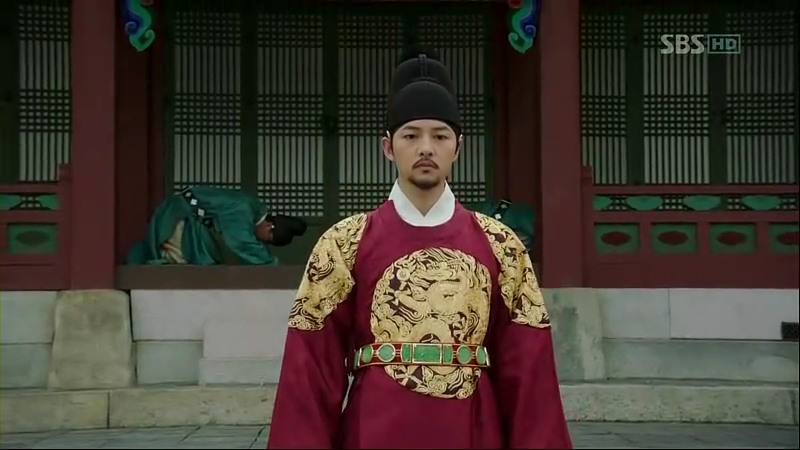
King Sejong, also with a red hongryongpo, ikseongwan, and gakdae
For special ceremonies, the civil officers will wear an outfit, jobok with a headgear called yanggwan.
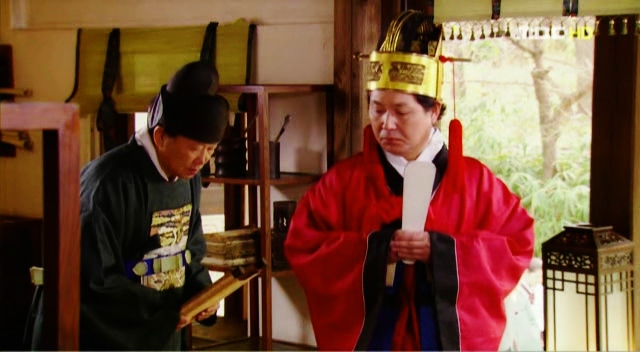
Chae-Kyung’s father wearing jobok and yanggwan during her wedding

In-Soo with a yanggwan during a praying ceremony at Sungkyunkwan
For very very special occasions such as ritual and formal ceremonies like wedding, daeryebok is worn together by the king, together with the special headdress, myonrugwan. The queen will wear an outfit, whether noeui or cheokui, with daesu, a type of headgear. Noeui was worn during Joseon Dynasty but later, during the Korean Empire, cheokui was made by revising the design of neoui.
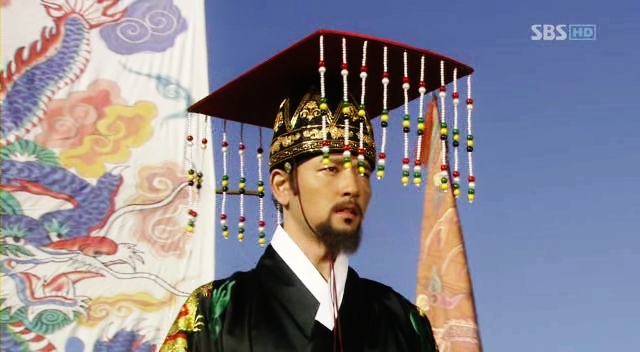
King Jeongjo donning daeryebok with myonrugwan
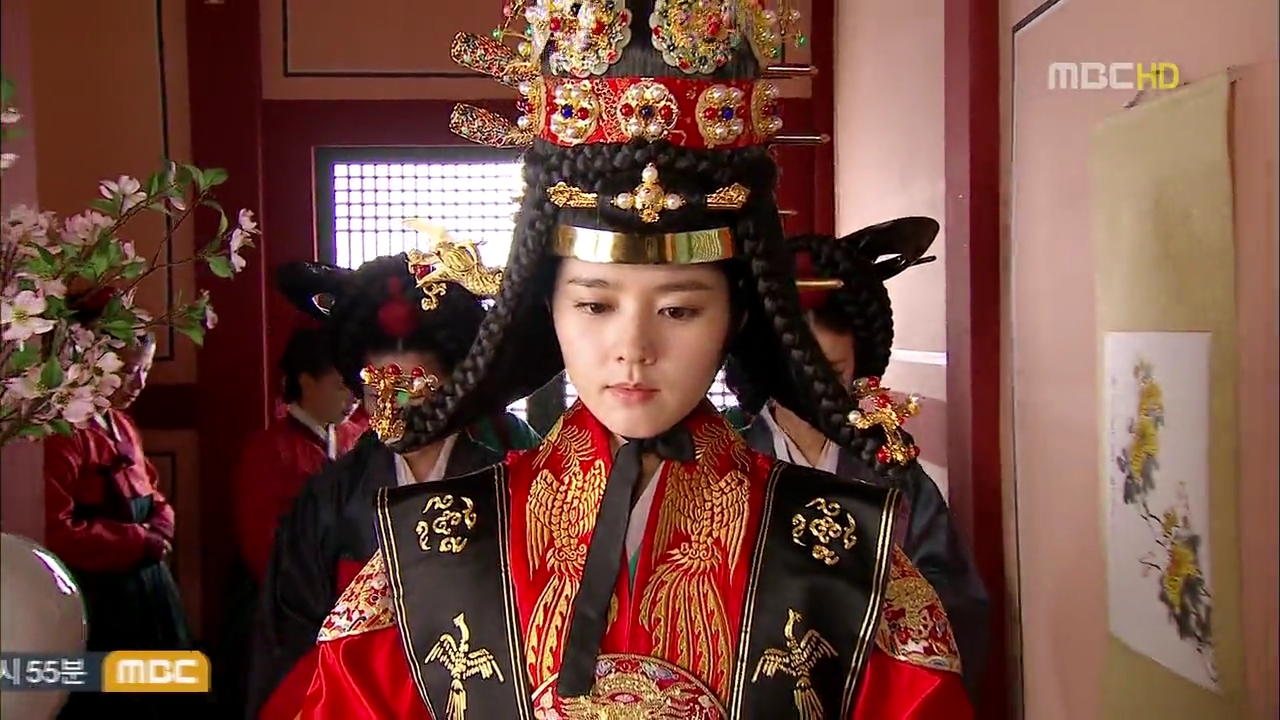 Yeon-Woo donning the noeui and daesu for her wedding ceremony with Lee Hwon
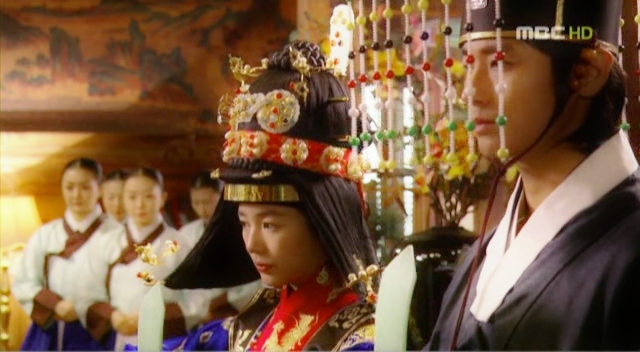
Lee Shin and Chae-Kyung during their wedding ceremony. He wears the daeryebok and myonrugwan while she is wearing blue cheokui together with the heavy daesu
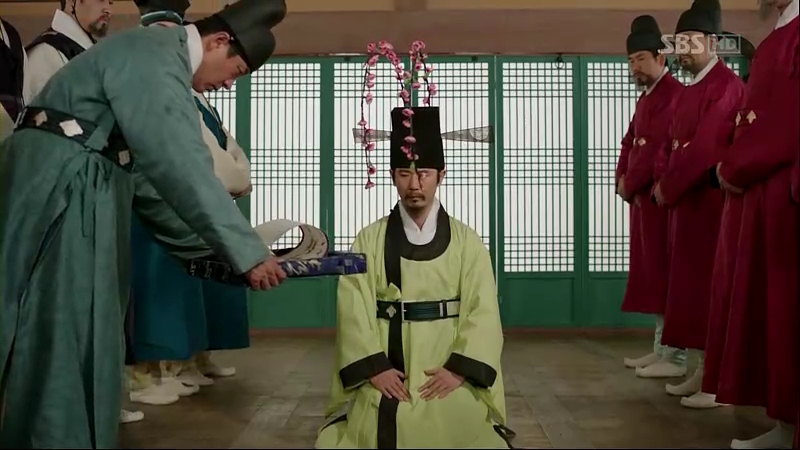
For those who have seen episode 17 of Tree with Deep Roots, there is a scene where Sejong presents his drink to the best student of gwageo, or royal government examination, while the student is wearing a hat with flowers branching out if it. The flowery hat is a special one called aisahwa, where it is a reward for the top scorer in the exam. The hanbok he’s wearing is called aengsam and it is worn by students when they are sitting for the royal government exam or for any official ceremonies of the government.
About the shoes and socks..ermm..it’s quite hard to capture it because it’s hidden under the hanbok and baji for most of the time. Luckily, my current addiction to sageuks makes me watch again Sungkyunkwan Scandal and I realize that it does have some beautiful shots of shoes. Now, let’s get to know them!
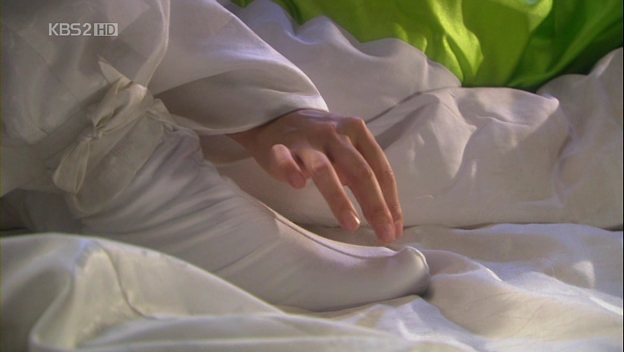
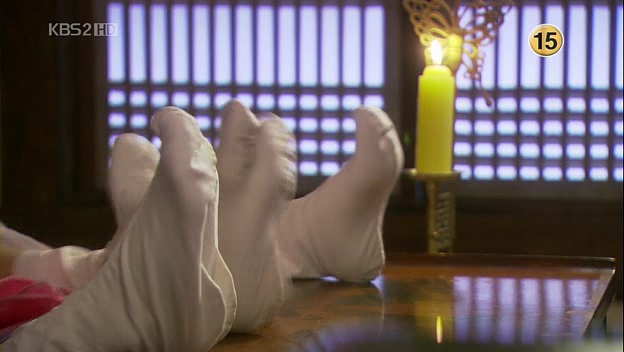
Beoseon (버선) is the general term for socks. They are worn by everyone regardless of the social statuses for protection and warmth. Beoseon are made from white cloth. Their shapes, types and sewing methods differ according to gender.

Jipsin (짚신) is a type of sandals made from straw. They are worn by commoners, servants, and people going for outing (usually scholars). As they are pretty durable and affordable, they are widely used and chosen as daily footwear.
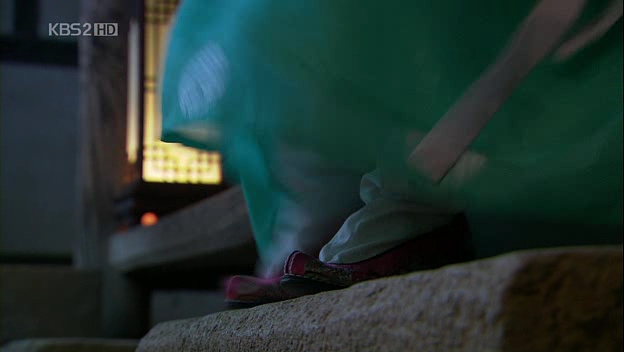
Hye (혜) are low cut shoes, like loafers and flats that we have today. They are many variations of hye for men and women. Women’s shoes usually have pointed fronts while men’s shoes have blunt fronts. One of the women’s shoes, unhye (운혜), are made from silk and decorated with colorful silk in shapes of clouds. As they are quite pricey, they are only worn by yangban women. At special occasions like weddings, commoners are allowed to wear unhye.
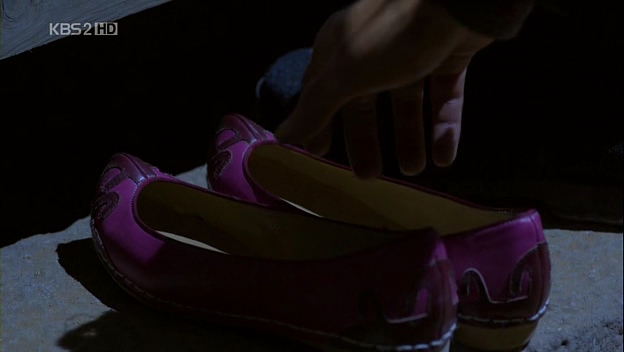
Danghye (당혜) are another type women’s shoes made from leather. They are decorated with scroll decoration. They might look similar to the men’s taesahye, but danghye have pointed fronts and have more color variations.
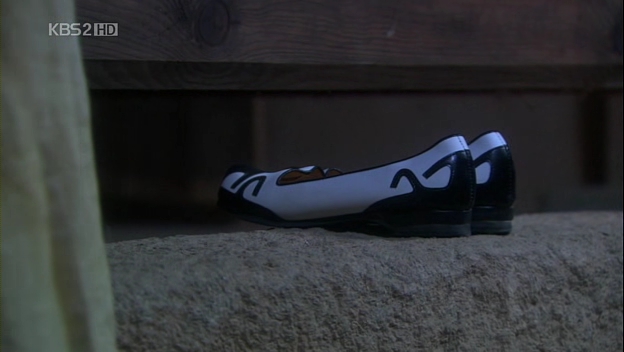
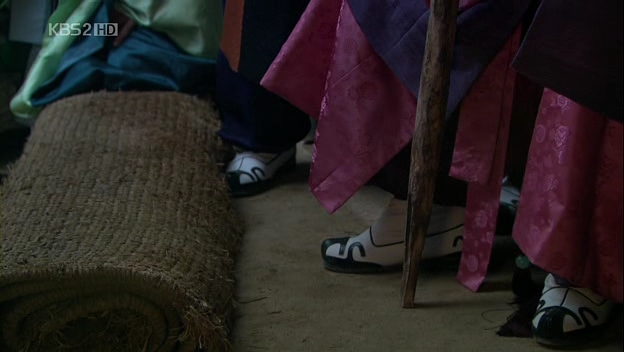
Taesahye (태사혜) are men’s shoes. Made from animal skin with scroll decoration and lined with silk inside, only the yangban men could afford to buy taesahye.
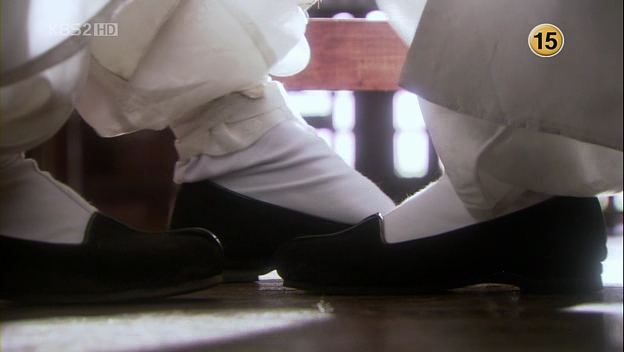
Heukhye is another type of men’s shoes, probably the most common ones after jipsin. They are made from leather and fleece, most of the time black in color. Officials, scholars, and yangban men wear them as parts of their daily garments.
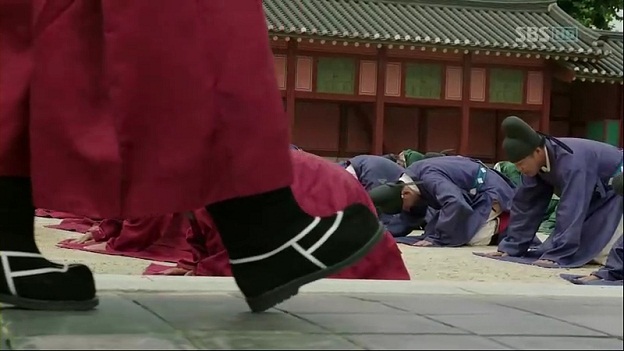
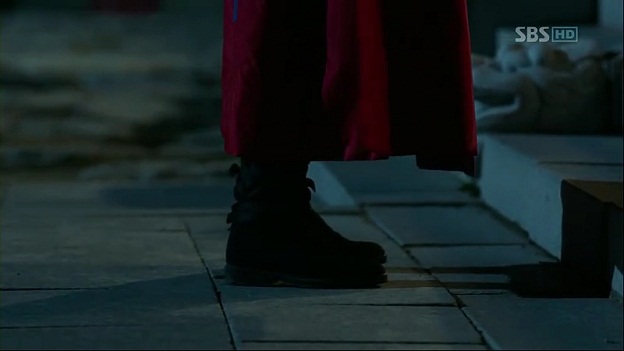
Hwa (화) – general term for boots. Made from leather or velvet, they are usually black in color. They are used by guards, government officers and court members together with their official garments. Sometimes, hwa made from more affordable animal skin are also worn by those who have an active lifestyle, such as people who travel a lot and swordsmen (Think Moon Jae-Shin, Lee Dae-Gil, Kang Chae-Yoon, or Yoon Pyung).
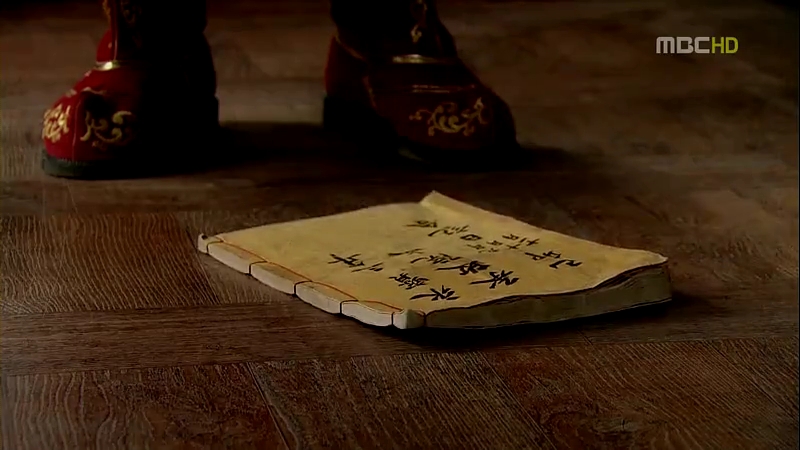
Lee Hwon’s hwa is a little bit unique: matching red color with his royal robe and gold patterns sewn on them.
With the footwear section somehow covered, the mini lesson of traditional Korean clothing is now over! Yeay! But that doesn’t mean I’ll just leave this post like this. I f I do encounter some new things about them, I’ll just update or put any additional parts in the entry. If you have any inquiries about this, just drop by and ask me. Although I’m not that knowledgeable about it (and I’m not a Korean either^^;), maybe I could help you to find what you’re curious about. Thanks for spending your time to read this lengthy post^^
For more details about the clothing and the ornaments:
- Moon, Sun, and Stars in Hanbok
- Joseon’s Court Attire: Kdrama Style
- Hanbok for Men: Kim Boong-Do’s Style
- Hanbok for Women: Lee Se-ryung’s Style
- Rings and Earrings: throughout the Dynasties
- A Guide to Joseon Hairstyles and Headgears
Image credit : me and various sites
 the talking cupboard
Thank you for the insights. I was wondering though, for the manggeon, do the wearers never take them off? It seems like they sleep, eat and bathe with it on?
Almost likely, since it’s used to hold the sangtu or topknot. Maybe they adjusted it when they were combing and tidying up their hair 🙂 We’ll never see that in a drama since the coordi who did all that. hehe
Daebak!
You worked hard for this artie.
Finally I know anything about Hanbok.
I will make this as source to write such article in my language.
Kamsahamnida!
Thank you so much for this in-depth post on Korean clothing! As a ignorant westerner I’m trying to find out as much as I can about the Joseon Dynasty culture and clothing in the very late 16th century as well as the early to mid 17th century.
It really hard to find any comprehensive and detailed resources (at least in England) so once again thanks a lot!
If you happen to embark on any other posts regarding period Korean clothing i’d love to see another detailed analysis on say Korean armour or say the differences between Joseon Dynasty clothing and Chinas Ming Dynasty as there were quite a few similarities from what I can tell.
You’re welcome!
Well..just like what you said, the resources are so limited on the web and I’m still trying to search for relevant sources about the armour and the military clothes, but so far no luck. I encountered a few journals but they’re locked. As far as I know, Joseon’s clothing were mostly modeled after the clothing worn during the Dynasties of China. With the Confucianism influence on Joseon Dynasty, they adapted the clothing from the Ming Dynasty to further embodied the lifestyle of a true Confucian scholar.
That’s a great idea to begin with: comparing the clothing of Ming Dynasty with Joseon Dynasty. I’ll try looking around! Thanks for the tip 🙂
Hi, I was finding something related to traditional things in Korean dramas and discovered your blog ^^ Could I translate your writings and findings on hanbok in drama into Vietnamese? ^^ We will have a soft periodical in the format of pdf or image files. Then I am seeking some information related to traditions in Korean dramas and publish into it. Our offline periodicals are free and non-profit, just for sharing to Vietnamese members interested in Korean culture and dramas in our forum 😀 This time, I am concentrating on hanbok in my bias drama “Sungkyunkwan Scandal”, then your entry is so great and informative. Therefore, I would like to ask for your credit. I will translate and modify a little as I have to use Vietnamese tone in displaying the article. If you agree, when the article is done, I will send to you for review ^^
Hope to hear from you!
Hello! Wow, I’m so sorry for the late reply. I don’t know how the comment ended up in the spam box ㅡㅡ;
That’s really good to hear! A nice project and I’m honored to be part of it 🙂 It’s okay to use this entry but I’m also referring to various sources, so you can take a look at them too. They’re good! I don’t really mind if this entry is modified or anything as long as the basic info is still there..all for the love of Korean culture! 😉
All the best for your project! ^^v
Thank you so much much much for your kindness 🙂 I will refer the links that you mentioned in the sources as well ^^
In addition, could I ask for your help related to traditional welcome ceremony in drama “Sungkyunkwan Scandal” ^^? I could not find details by searching, maybe my keywords did not works well 😀
(http://www.youtube.com/watch?v=BZubCkHKCVY&feature=relmfu) I saw some people cosplaying monsters and chasing students. Then students would run to the place in which the event was about to be held… I am really impressed by the scene and cultural beauty of the event but could not get more information in Internet ^^ Then, I try to post there, asking for your further explanation 😀
Really sorry for disturbance and posting sth not related to the topic of Korean Clothing entry ^^”
Aigoo…it’s okay, really! I’ll try looking around and I will get back to you if I found a good source about the welcoming ceremony 🙂
as long as it’s related to Korean culture, I’m more than willing to help! 😉
hi, i’m from Indonesia ^^
could i repost this one with indonesian language in my blog ?
visit me : mewmewhyorin.blogspot.com
thank’s before ^^
of course^^ just give me the credit~ 😉
thank’s a lot ^^
hi love the blog finally so much has been cleared up drom watching Dong YI and Hwang Jin Yi.
i have a few questions its an odd one i love the costumes and bits etc. but i like to know a costume through all the layers inside out , what and how many layers in the women wear underneath the hanbok , and what did they sleep in ?!?! how was its all put together ?
i know they are all bit odd , but there is no were that has any ifno except that they wore 5 petticoats and bloomers. or is that the jest ?
xxxxx
thanks for any help !
p.s do you by any chance know the clotheing differnace worn of the women in the court of Dong Yi.
xxxxx
Hello! ^^ I’m really glad you find the post helpful~
Well, on a normal day, women usually wear an undershirt of thin white material under the top. It’s like the top jacket or jeogori, but thinner and lighter. They will sleep in this undershirt. However, it also depends on the season. during winter in the old days, they would wear several layers of undershirt to keep their bodies warm, sometimes up to 7-8 layers. For the skirt or chima, a thin, white underskirt is worn under the outer skirt. When there’s any occasion, only then they would wear the petticoats or bloomers under the skirt to make the skirt look fuller.
If you’re referring to the attire of the queens and concubines in Dong Yi, queens usually have a dragon emblems on the front, back, and both shoulders. Their dangui, or ceremonial top coats are more elaborate, heavy with gold patterns compared to concubines. As for concubines, their dangui depends on their rank. For more info, you can refer to this post:
Hope this helps! 😉
thanks you very much for the quick reply . it helps loads . xxxx
Is there a name for Dong Yi’s investigator outfit (magenta vest and dark blue sleeves, skirt)? Thank you! This is a very informative post!
I think there are no special names for the outfit..the outfit is made up of the topcoat (jeogori) and skirt (chima) with the vest worn on top of the jeogori. Hope this helps 🙂
Hi, I would like to thank you because this post about traditional Korean clothing is really informative! ^^ and I was just wondering if I can repost this in my blog using Filipino language ? I will send you the link right after translating and posting in my blog . Of course I will give you the credit . 😀
Ah, you’re welcome! of course, it’s okay for me as long as you credit me 🙂
Thanks! ^^ I have a question, I know it’s kinda off-topic but..
When I am to go to Korea, is it possible for me to wear daeryebok with myonrugwan or red hongryongpo with ikseongwan and gakdae ? I want to have some pictures of me wearing those traditional clothes . That would be awesome ! ^^
haha I’m not sure myself since I’ve never been to Korea before ^^; I’ve seen people trying out the basic jeogori and chima/baji at the Korean Village and took pictures but never with the King/officer’s attire 🙂 Probably because of the attire itself which is not easy to get, not to mention the cost…but who knows, some places might have them 😉
Wow. This article was amazing! I can’t even imagine how long it took you to research all of this. I’m just thankful you took the time to research it and post it online, because I’m researching traditional Korean clothing at the moment for a story I wanted to write, but no matter where I looked, I couldn’t find what type of fabrics different classes of people wore. And then you have it right near the very top! And I loved the way you provided picture examples for everything you said. Well done, and thank you very much.
You’re welcome! 😉 It’s my pleasure to share what I know with others, especially about dramas and hanbok~
hello there…..
I am very interested with Korean clothing and am planning to have some tailored for my own use…. but I don’t know what materials they are made from or the patterns for them….
i am planning to have the following:
1. a pair of pajamas or sleeping garment ensemble
2. the working clothes of doctors in the palace especially the apron parts just like in “horse doctor”
sorry for the hassle….. thank you and I hope you could help me…. I am quite addicted to sageuk too….. 🙂
hello!
wow, I’m amazed that you want to make it yourself! I haven’t had the chance to try making it, hence I’m not that sure about the patterns. Some of the patterns I saw online was for sale, but maybe I haven’t found the free one yet. The fabric…hmmmm..I can only give suggestions, since I never actually see the real hanbok.
– for the pajamas, you can try using white silk or if you want to have thinner garments, try looking for thinner silk or other types of fabric that won’t make you sweat in the middle of the night.
– for the doctors’ hanbok….I think they basically use silk (if the hanbok is shiny) or thick cotton. but for the apron, I’m sure they use thick white cotton, or similar fabric that is easy to be washed.
sorry for not being that much of help! ><" hope these suggestions will give you some ideas about it…
bunları nerden satın alabilirim
do you know the name of the hat that Kang Chae-yoon in Tree with deep roots the black hat he wears with black robes TY. heres the link to the picture http://s630.beta.photobucket.com/user/dramabeans/media/drama/2011/TWDR17/TWDR17-00533.jpg.html?sort=3&o=18
it’s a variation of satgat or the conical hat. Unlike the usual brown colour, this time Chae-yoon wears the one dyed with black color.
Hope this helps 🙂
Yes i thought that also, but isn’t there another certain name for that particular hat? but thx for your answer
Almost forgot but in the movie Warrior Baek Dong Soo the Hoksa Chorong assassins also wear the same hat i figured maybe it is some type of hat worn by assassins since Chae-Yoon wore it when he was about to assassinate the King. I’m not sure if it’s going to help at all but thought i should mention
you’re right about that. the hats look a little different but I still haven’t found the exact name of them ㅠㅠ
have found any news about the hat? thx
I returned because I found a hat not on your list: http://s247.beta.photobucket.com/user/kimYunmi/media/ScreenShot2013-01-04at21607AM_zps15032f5d.jpg.html
The one on the right, not the samo. I got the screen shot from Horse Doctor… Episode 25? Something like that.
What is it?
I have also seen in Jeon Woo Chi a hat that looks like the guard hat without the crowning bit, the beads, the feather or the ornamental knot thing. It looks like it’s made out of black material and a shorter rim? It’s definitely not the Noble person’s gat, it has a rounded crown. Grunts usually wear it. You’re also missing the Hwarang hat, I think. I noticed it’s used on some guards in Joseon??
Hello again! 😀 It’s been a while~
Not sure about the hat in the pic but it does look like a tanggeon, but made from black cloth. I have to look at it closer but so far, haven’t found something about it.
About the guard hat, I think it’s the same hat but without the adornments, probably because of the wearer’s rank. The guard hat, beonggeoji/jeonrip, has semi spherical crown.
And the Hwarang hat used by the guards..do you mean the exact small conical hat with a pair of feathers or the red hat with a pair of feathers?
Hwarang hat… minor guards wear it you said.
I got a better picture and figured out it’s the same hat as the one Jeon Woochi wears all the time, but tied differently. http://i247.photobucket.com/albums/gg138/kimYunmi/ScreenShot2013-01-15at110817AM_zpsbffc0fb4.jpg (Episode 25 of Horse Doctor, the scene where they are talking about the brain hemorrhage thingy…) It’s not the hogeon wear though… or at least it’s a variation. (looks kinda like a closed paper bag?) It’s tied differently and doesn’t have the rounded top.
Compare to Jeon Woochi’s hat… http://i1058.photobucket.com/albums/t413/javabeansdb/drama/2012/jeonwoochi/woochi1/woochi1-00306.jpg Low level scholar hat?
But it was tied differently. Also showed up in Kim Suro. Not sure why it’s tied that way though, v the other way…
The other hat, which I could not find because it was on a minor character roughly looks like this:

with the same texture as this: http://i247.photobucket.com/albums/gg138/kimYunmi/ScreenShot2013-01-15at110410AM_zps21c8a547.jpg (well looks rough like that, instead of the gat which has fine horse hair). Yeah, the same guy from Sungkyunkwan Scandal wearing the same exact thing. (I think that’s hilarious because from the screen shot you can’t tell which drama it comes from.)
And then other crazy hat-ness:
http://i1058.photobucket.com/albums/t413/javabeansdb/drama/2012/jeonwoochi/woochi1/woochi1-00010.jpg Small low level guard hat. (Jeon Woochi, episode 1)
Episode 5 of Jeon Woochi: http://i1058.photobucket.com/albums/t413/javabeansdb/drama/2012/jeonwoochi/woochi1/woochi5-00262.jpg A variation on a paerangi? or is it a satgat? Or did a paerangi and a satgat have a child?
http://i1192.photobucket.com/albums/aa324/girlfridaydb/drama/2012/Jeonwoochi/woochi16/woochi16-00541.jpg Episode 16 of Jeon Woochi. ’cause it’s funny… Is it a gwidong?
http://i247.photobucket.com/albums/gg138/kimYunmi/ScreenShot2013-01-15at112800AM_zps6499df0e.jpg from Kim Suro (lost the episode number, Either 1 or 2) During her wedding, albeit, Three Kingdoms Gaya.
Just wondering, but would the woman’s sewing department also be in charge of making hats in Joseon for the guards, etc? TT Couldn’t find the info. Who made all these hats anyway?
That covers my hat curiosity. I still regret that I’m writing about Gaya instead, so my hat choices are limited to manggeon, ornaments on the mangeon, hair ribbon around the top knot, decoration for the ribbon around the top knot, stamped crowns, and Jeon Woochi’s type of hat. I wanted a satgat for my assassin still, even if it makes no sense… >.<;; So much for that.
I think I have to do a separate post on hats and head gears 😀 There are lots of them and I am now confused because there are so many variations! That closed paper bag hat is worn by the scholars but I can’t remember the exact name 😦 I never saw the differently tied one before but maybe it’s just the variations made by the props team. I found a good source on the hats but still need to do some additional hunting. I will definitely do the post as soon as possible~ 😉
About the people who made hats, most of them were men who worked as a hat maker. There are women involved but maybe women were more focused on cloth making.
I’m not sure whether satgat was brought in as early as during Gaya. You can always refer to the dramas. But then, it’s up to your imagination since there aren’t that much of info left about the hats (maybe there are but mostly in Korean). Wish you all the best! 😀
sorry,,, 또 왔어요ㅎ Again…. 누가 좀..해석 좀 해주세요ㅎ
많은 자료를 알려드리고 싶었는데 제가 영어 무지한이라…ㅋ 미안해요 sorry
전 한국복식을 전문적으로 공부하는 학생이에요..
사진을 그대로 붙어넣기를 하고 싶지만 하는 방법을 몰라서 링크로 남겨요..
여기 복원사진들은
고려시대 불화속이나 회화, 벽화, 흙인형, 기록등으로 복원한 거예요..
Goryeo hanbok
http://dbscthumb.phinf.naver.net/1694_000_1/20130314194919148_7D56XPQ8Q.jpg/z2_cp02040043000.jpg?type=w460_2
http://dbscthumb.phinf.naver.net/1694_000_1/20130314194919648_6EB55DUZ9.jpg/z2_cp02040043000.jpg?type=w460_2
http://dbscthumb.phinf.naver.net/1694_000_1/20130314194919742_VVVFWU3C0.jpg/z2_cp02040043000.jpg?type=w460_2
http://dbscthumb.phinf.naver.net/1694_000_1/20130314195034054_4J42D50JZ.jpg/z2_cp02040045000.jpg?type=w460_2
http://dbscthumb.phinf.naver.net/1694_000_1/20130314195034482_T1STA1FFX.jpg/z2_cp02040045000.jpg?type=w460_2
http://dbscthumb.phinf.naver.net/1694_000_1/20130314195040055_EWRHVKAJY.jpg/z2_cp02040045000.jpg?type=w460_2
http://dbscthumb.phinf.naver.net/1694_000_1/20130314195116849_NCG841VI5.jpg/z2_cp02040046000.jpg?type=w460_2
http://dbscthumb.phinf.naver.net/1694_000_1/20130314195118133_NFNOWBTR3.jpg/z2_cp02040046000.jpg?type=w460_2
http://dbscthumb.phinf.naver.net/1694_000_1/20130314195118506_660I2CL36.jpg/z2_cp02040046000.jpg?type=w460_2
http://dbscthumb.phinf.naver.net/1694_000_1/20130314195152899_KTUFADD0J.jpg/z2_cp02040047000.jpg?type=w460_2
http://dbscthumb.phinf.naver.net/1694_000_1/20130314195158980_8H3TITIBL.jpg/z2_cp02040047000.jpg?type=w460_2
http://dbscthumb.phinf.naver.net/1694_000_1/20130314195159063_IAKTD3MB9.jpg/z2_cp02040047000.jpg?type=w460_2
http://dbscthumb.phinf.naver.net/1694_000_1/20130314195228807_9XP48RCA5.jpg/z2_cp02040048000.jpg?type=w460_2
http://dbscthumb.phinf.naver.net/1694_000_1/20130314195229043_D3MC8G0OB.jpg/z2_cp02040048000.jpg?type=w460_2
http://dbscthumb.phinf.naver.net/1694_000_1/20130314195230524_ZW2MAXMJ0.jpg/z2_cp02040048000.jpg?type=w460_2
↑ in regular sequence.. empress, princess nogook hanbok, queen hanboks,,
아이고 너무너무 감사해요! 너무 고마워요 ㅜㅜㅜㅜㅜ 한국어 좀 아기하는대…근대 너무 모자라서..미안합니다…
진짜진짜 고맙슴니다!! 땡큐~^^ 사진을 너무 예뻐요 😉
도배해서 미안해요sorryㅠㅠ 근데 꼭 알려드리고 싶었어요 ㅠ ㅠ
이런 ㅜㅜ 안보이는 링크가 많네요ㅠㅠ 만약 오류가 뜨면
if link error…
↓
http://terms.naver.com/entry.nhn?cid=4429&docId=1723358&mobile&categoryId=4429
many goryeo hanboks…
naver encyclopedia..
translator.. google chrome 사용해서 들어가보세요…
많이 링크해드리고 싶은데 자꾸 error가 뜨네요 ㅠㅠ
korea website
many data
↓
www,naver.com 여기서
한국말(korean)로 ‘고구려 고분벽화(mean: koguryeo ancient tomb mural )’ search …
many koguryeo hanboks…..
or google search… ‘koguryeo ancient tomb mural’ ok
and search.. ‘silla golden oooo’ ex) silla golden crown
드라마 선덕여왕(drama Queen Seondeok)시절의 황금 유물들을 볼 수 있습니다
자세히.. 제대로…알려드리고 싶었는데 정말 죄송해요ㅜㅜ 정말 알려 드리고 싶은데… 부디 많은 도움이 되어드렸으면 좋겠습니다
좋은 하루 보내세요,,,,have a good day
아니에요..죄승은 무슨말입니까? 전 너무 좋아해요 🙂 이럭해 많은 info는 너무 기뻐씁니다~^^ 진짜 진짜 감사합니다! 고맙슴니다! 잘 보겠습니다!
아, 저는 조선시대 갓 & 관 info 찾고 싶어는데 근대…한국어 너무 모자라서..아이고, 저는 한복 많이 좋아해요, 또 배우고 싶어는데 ㅠㅠㅠㅠ
↑ same picture
empress, princess nogook hanbok, queen hanboks
http://terms.naver.com/entry.nhn?cid=4429&docId=1723394&mobile&categoryId=4429
http://terms.naver.com/entry.nhn?cid=4429&docId=1723396&mobile&categoryId=4429
http://terms.naver.com/entry.nhn?cid=4429&docId=1723397&mobile&categoryId=4429
http://terms.naver.com/entry.nhn?cid=4429&docId=1723398&mobile&categoryId=4429
http://terms.naver.com/entry.nhn?cid=4429&docId=1723399&mobile&categoryId=4429
a court lady..궁녀 宮女
http://dbscthumb.phinf.naver.net/1694_000_1/20130314195259941_79MZDJ2FA.jpg/z2_cp02040050000.jpg?type=w460_2
http://dbscthumb.phinf.naver.net/1694_000_1/20130314195300178_LQNM5AJ4G.jpg/z2_cp02040050000.jpg?type=w460_2
http://dbscthumb.phinf.naver.net/1694_000_1/20130314195302476_W3HNI0W3Q.jpg/z2_cp02040050000.jpg?type=w460_2
http://dbscthumb.phinf.naver.net/1694_000_1/20130314195328915_8S0HNROOV.jpg/z2_cp02040051000.jpg?type=w460_2
http://dbscthumb.phinf.naver.net/1694_000_1/20130314195332434_ANSIN49DN.jpg/z2_cp02040051000.jpg?type=w460_2
http://dbscthumb.phinf.naver.net/1694_000_1/20130314195333265_RFO4UE6OS.jpg/z2_cp02040051000.jpg?type=w460_2
http://dbscthumb.phinf.naver.net/1694_000_1/20130314195401701_09GO6ZQCF.jpg/z2_cp02040052000.jpg?type=w460_2
http://dbscthumb.phinf.naver.net/1694_000_1/20130314195404925_NHB4DW70J.jpg/z2_cp02040052000.jpg?type=w460_2
http://dbscthumb.phinf.naver.net/1694_000_1/20130314195405659_1H1UOUK59.jpg/z2_cp02040052000.jpg?type=w460_2
http://dbscthumb.phinf.naver.net/1694_000_1/20130314195430913_APPICPLD5.jpg/z2_cp02040053000.jpg?type=w460_2
http://dbscthumb.phinf.naver.net/1694_000_1/20130314195432429_LQMKOC38R.jpg/z2_cp02040053000.jpg?type=w460_2
http://dbscthumb.phinf.naver.net/1694_000_1/20130314195433836_97KDN97LS.jpg/z2_cp02040053000.jpg?type=w460_2
a court lady..궁녀 宮女 Goryeo hanbok
http://terms.naver.com/entry.nhn?cid=4429&docId=1723400&mobile&categoryId=4429
http://terms.naver.com/entry.nhn?cid=4429&docId=1723401&mobile&categoryId=4429
http://terms.naver.com/entry.nhn?cid=4429&docId=1723402&mobile&categoryId=4429
http://terms.naver.com/entry.nhn?cid=4429&docId=1723403&mobile&categoryId=4429
http://terms.naver.com/entry.nhn?cid=4429&docId=1723404&mobile&categoryId=4429
lady,noblewoman
http://dbscthumb.phinf.naver.net/1694_000_1/20130314195533310_GRGVHL4WG.jpg/z2_cp02040056000.jpg?type=w460_2
http://dbscthumb.phinf.naver.net/1694_000_1/20130314195533729_2PKFDPCO1.jpg/z2_cp02040056000.jpg?type=w460_2
http://dbscthumb.phinf.naver.net/1694_000_1/20130314195536539_WLS4AKO2J.jpg/z2_cp02040056000.jpg?type=w460_2
http://dbscthumb.phinf.naver.net/1694_000_1/20130314195557850_SJLCQYROR.jpg/z2_cp02040057000.jpg?type=w460_2
http://dbscthumb.phinf.naver.net/1694_000_1/20130314195558252_4LQVSL1HG.jpg/z2_cp02040057000.jpg?type=w460_2
http://dbscthumb.phinf.naver.net/1694_000_1/20130314195624397_0FF1UPKJQ.jpg/z2_cp02040058000.jpg?type=w460_2
http://dbscthumb.phinf.naver.net/1694_000_1/20130314195624783_6VZNYW2V0.jpg/z2_cp02040058000.jpg?type=w460_2
http://dbscthumb.phinf.naver.net/1694_000_1/20130314195625709_9F3HYHEVW.jpg/z2_cp02040058000.jpg?type=w460_2
http://dbscthumb.phinf.naver.net/1694_000_1/20130314195652620_Q12OJX6DO.jpg/z2_cp02040059000.jpg?type=w460_2
http://dbscthumb.phinf.naver.net/1694_000_1/20130314195652898_DRRTD3RMS.jpg/z2_cp02040059000.jpg?type=w460_2
http://dbscthumb.phinf.naver.net/1694_000_1/20130314195654916_0UKQL9L1V.jpg/z2_cp02040059000.jpg?type=w460_2
http://dbscthumb.phinf.naver.net/1694_000_1/20130314195725325_162B329IG.jpg/z2_cp02040060000.jpg?type=w460_2
http://dbscthumb.phinf.naver.net/1694_000_1/20130314195727803_USSMAHUHK.jpg/z2_cp02040060000.jpg?type=w460_2
http://dbscthumb.phinf.naver.net/1694_000_1/20130314195748023_XPBLDL6XG.jpg/z2_cp02040061000.jpg?type=w460_2
http://dbscthumb.phinf.naver.net/1694_000_1/20130314195749243_PDFUE398M.jpg/z2_cp02040061000.jpg?type=w460_2
http://dbscthumb.phinf.naver.net/1694_000_1/20130314195751970_D6IMVM8ZQ.jpg/z2_cp02040061000.jpg?type=w460_2
http://dbscthumb.phinf.naver.net/1694_000_1/20130314195840627_GBJDOKDLT.jpg/z2_cp02040063000.jpg?type=w460_2
http://dbscthumb.phinf.naver.net/1694_000_1/20130314195843102_EERV8RWKQ.jpg/z2_cp02040063000.jpg?type=w460_2
http://dbscthumb.phinf.naver.net/1694_000_1/20130314200001315_VBZ8D5RR3.jpg/z2_cp02040066000.jpg?type=w460_2
http://dbscthumb.phinf.naver.net/1694_000_1/20130314200004298_FHVCPJGL5.jpg/z2_cp02040066000.jpg?type=w460_2
http://dbscthumb.phinf.naver.net/1694_000_1/20130314200008067_KGXDCN73U.gif/z2_cp02040066000.gif?type=w460_2
http://dbscthumb.phinf.naver.net/1694_000_1/20130314200041875_0VGBE0HFT.jpg/z2_cp02040067000.jpg?type=w460_2
http://dbscthumb.phinf.naver.net/1694_000_1/20130314200042578_40Z2A4WH8.jpg/z2_cp02040067000.jpg?type=w460_2
http://dbscthumb.phinf.naver.net/1694_000_1/20130314200042604_Q06FVRPSS.jpg/z2_cp02040067000.jpg?type=w460_2
noblewoman, goryeo hanbok
http://terms.naver.com/entry.nhn?cid=4429&docId=1723405&mobile&categoryId=4429
http://terms.naver.com/entry.nhn?cid=4429&docId=1723406&mobile&categoryId=4429
http://terms.naver.com/entry.nhn?cid=4429&docId=1723407&mobile&categoryId=4429
http://terms.naver.com/entry.nhn?cid=4429&docId=1723408&mobile&categoryId=4429
http://terms.naver.com/entry.nhn?cid=4429&docId=1723409&mobile&categoryId=4429
http://terms.naver.com/entry.nhn?cid=4429&docId=1723410&mobile&categoryId=4429
http://terms.naver.com/entry.nhn?cid=4429&docId=1723411&mobile&categoryId=4429
http://terms.naver.com/entry.nhn?cid=4429&docId=1723412&mobile&categoryId=4429
http://terms.naver.com/entry.nhn?cid=4429&docId=1723413&mobile&categoryId=4429
http://terms.naver.com/entry.nhn?cid=4429&docId=1723414&mobile&categoryId=4429
http://terms.naver.com/entry.nhn?cid=4429&docId=1723415&mobile&categoryId=4429
http://terms.naver.com/entry.nhn?cid=4429&docId=1723416&mobile&categoryId=4429
nobless children ,goryeo hanbok
boy
http://terms.naver.com/entry.nhn?cid=4429&docId=1723417&mobile&categoryId=4429
http://terms.naver.com/entry.nhn?cid=4429&docId=1723418&mobile&categoryId=4429
http://terms.naver.com/entry.nhn?cid=4429&docId=1723419&mobile&categoryId=4429
girl
http://terms.naver.com/entry.nhn?cid=4429&docId=1723420&mobile&categoryId=4429
http://terms.naver.com/entry.nhn?cid=4429&docId=1723421&mobile&categoryId=4429
http://terms.naver.com/entry.nhn?cid=4429&docId=1723422&mobile&categoryId=4429
commoner
http://dbscthumb.phinf.naver.net/1694_000_1/20130314200404519_1U2F0HQWF.jpg/z2_cp02040076000.jpg?type=w460_2
http://dbscthumb.phinf.naver.net/1694_000_1/20130314200447842_UENXSR7A4.jpg/z2_cp02040078000.jpg?type=w460_2
http://dbscthumb.phinf.naver.net/1694_000_1/20130314200512219_UKY2NA57N.jpg/z2_cp02040079000.jpg?type=w460_2
http://dbscthumb.phinf.naver.net/1694_000_1/20130314200512248_QL48DJEJW.jpg/z2_cp02040079000.jpg?type=w460_2
http://dbscthumb.phinf.naver.net/1694_000_1/20130314200552217_9HFDXU87G.jpg/z2_cp02040081000.jpg?type=w460_2
http://dbscthumb.phinf.naver.net/1694_000_1/20130314200552821_GLB1SBZYG.jpg/z2_cp02040081000.jpg?type=w460_2
http://dbscthumb.phinf.naver.net/1694_000_1/20130314200618621_Y2SIIUZHZ.jpg/z2_cp02040082000.jpg?type=w460_2
http://dbscthumb.phinf.naver.net/1694_000_1/20130314200619193_T2VBSEXJS.jpg/z2_cp02040082000.jpg?type=w460_2
http://dbscthumb.phinf.naver.net/1694_000_1/20130314200644467_MLIUH9FEL.jpg/z2_cp02040083000.jpg?type=w460_2
http://dbscthumb.phinf.naver.net/1694_000_1/20130314200645836_5WL7NVSR7.jpg/z2_cp02040083000.jpg?type=w460_2
commoner ,goryeo hanbok
male
http://terms.naver.com/entry.nhn?cid=4429&docId=1723423&mobile&categoryId=4429
http://terms.naver.com/entry.nhn?cid=4429&docId=1723424&mobile&categoryId=4429
http://terms.naver.com/entry.nhn?cid=4429&docId=1723425&mobile&categoryId=4429
http://terms.naver.com/entry.nhn?cid=4429&docId=1723426&mobile&categoryId=4429
http://terms.naver.com/entry.nhn?cid=4429&docId=1723427&mobile&categoryId=4429
female
http://terms.naver.com/entry.nhn?cid=4429&docId=1723428&mobile&categoryId=4429
http://terms.naver.com/entry.nhn?cid=4429&docId=1723429&mobile&categoryId=4429
http://terms.naver.com/entry.nhn?cid=4429&docId=1723430&mobile&categoryId=4429